Good luck.
With the title of my blog, I don't mean to suggest that the play's action itself doesn't make sense... In fact, I'm amazed that I've never heard of this play before I took this class. I found the characters, the action, the dialogue, and the story itself to pack a big punch. Each character, even the villains, are given such incredible detail and nuance to their personality--many of the more tragic characters are redeemed in the end (thanks to Ashley Arcel for pointing that out so well in her blog entry). And, of course, since college-aged students love sexual innuendo, I have to say that the dialogue in this play is masterful and quite filthy. I didn't even need to look at the footnotes to tell that Cloten was a sick, perverted bastard!
I am not yet able to completely describe how Cymbeline makes sense in the grand scheme of Shakespeare's romances as far as its relation to the mythic, as I have not yet completed the rest of them. My initial impression of this romance, as it compares to some of Shakespeare's other very, very dark tragedies (especially King Lear) is that while they maintain a similar arc, the ending tends to share more in common with the present-day narrative in American films.
This doesn't apply to all works of the present day, but it seems as if audiences are willing to accept just about any insane, dark, twisted elements in a story so long as things turn out all right in the end. If a character has been through hell, then they better make it out alive. Not to disparage the end of Cymbeline as a "Hollywood ending" (even though everything fell completely into place quite conveniently), but the characters we know and love make it out just fine. By and large, I think it works. Perhaps if Cymbeline ended in a blood bath like King Lear or Hamlet, its reputation would be more prominent because of that (I have no way of knowing, just a hunch).
Based on my current impressions on Cymbeline, what seems out of place when trying to categorize it as more of a comedy versus a drama makes for an interesting product, nonetheless. It's amazing how much of a model this is for what we see as a standard for entertainment today. A problematic set-up where everything that can possibly go wrong does, and in the end the difficulties are reconciled in such a way that it doesn't feel too out of place. Graned, the god Jupiter makes an appearance, but it felt okay with me. After all, deus ex machina has become so common in today's popular culture that most non-English majors (and even plenty who are) could see one without even knowing it.
Next up: Pericles.
Monday, March 28, 2011

Monday, March 21, 2011
Antony and CLEOPATRA (IN ALL CAPITAL LETTERS)
"Success in heroic love being impossible, better to fail heroically than to succeed in mediocrity". -- Northrop Frye
Antony and Cleopatra is sprawling. A huge cast of characters, numerous locations, a very fragmented and fast-paced middle portion with plenty of scenes, and very richly developed main players. Though Antony is no slouch, the real emphasis, of course, is on Cleopatra.
I admit that for as realistic and non-mythological as this play is in comparison to the other plays we have studied, a lot of it went over my head. I'll be lucky if I even got the 24% of Shakespeare that Dr. Sexson equated to the 89% of Stephen King. Regardless, there's a lot to be said about the titular characters. Inherent in the play's setting is a lot of dichotomy between Antony and Cleopatra and the worlds they live in. As mentioned in class, the Roman and the Egyptian societies have vastly different characteristics-- white versus black, masculinity versus femininity , reason versus passion, fluid and indistinct versus fixed, and many, many more.
As mentioned in Northrop Frye's look at Antony and Cleopatra, the character of Antony does not adhere to one society's tendencies completely. He finds himself drifting back and forth between the world of desire and love of Cleopatra's Egypt and the politics and heroism of Caesar's Rome. Frye noted that Antony has a very interesting place on the typical stratification of literary characters, which looks a little something like this:
- Divine beings, or a hero descended from the gods.
- Romantic heroes and lovers. Human, but not subject to ordinary limitations.
- Kings and other commanding figures in social or military authority.
- The ordinary folk.
- Unfortunate people, assumed to possess less freedom that us.
(132-133)
On the other hand, you have Cleopatra--a much more colorful character around whom the play revolves.. and there's no doubt about the fact that she knows it, too. The discussion continued ad infinitum about the character of Cleopatra very much embodying drama with every grand gesture and emotional tirade. As queen of Egypt, she very much already is a goddess (134)--so why shouldn't she act like one?
I found the fact that her dramatic style being associated with the constant presence of an audience of some sort present with her to create an interesting but confusing portrait of her. As big as her emotions are played out, as violently as she treats the messengers who displease her, as dramatic as her death really is, do we really know anything about the real Cleopatra? To me, there always seemed to be a sense of artifice in every action, even if the emotion behind it was one of sincerity.
With Cleopatra that outrageousness and power create a figure so unmistakably her that, as Frye said, she fully expected to maintain her kingdom, her man, and her goddess persona in the afterlife. I would say that her ferocity, passion, and taste for the theatrical coupled with Antony's spectacular (though failed) attempt at maintaining love with Cleopatra makes for the stuff of legends. Shakespeare certainly has a way of escalating the business of humans to mythic proportions.
Wednesday, March 9, 2011
Final Thoughts on "Lear"
Before I dig into Antony & Cleo, I thought I'd get this Lear business wrapped up.
My secondary reading for this class is Frye's On Shakespeare book, which has a lot of fascinating things to say about King Lear, some of which was covered in class. Specifically, the recurrence of the words "nothing", "nature", and "fool". I found the concept of nature to be very interesting... or for this occasion we'll give it a capital "N".
Lear takes place in pre-Christian times, as we know, but the concept of Nature having a tiered structure is a very compelling one that places a lot of Christian/mythic dimension to the story. As Frye described Nature, it has four levels:
1. Heaven (or wherever God lives), represented by the sun and moon (and the stars, perhaps? Such as Edmund's contemplation of his "baseness" to the stars)
2. "Unfallen" Nature (such as the Garden of Eden)
3. "Fallen" Nature (in which animals survive well enough while humans struggle)
4. The demonic world (which may represent itself in the vile elements of Nature, such as the storm in the play)
Taking into account the notion of "displaced myth", Frye goes deeper in describing what the world of Lear is like... There is no God or gods but only occasionally deified representations, the "unfallen" Nature exists only in the goodness of select characters, the "Fallen" existence of men renders them animals, and that the "hellish" elements are found in the madness of Lear. It's an incredibly grim, bleak world indeed.
Reading King Lear comes as a bit of a shock considering that the three previous plays we have examined are comedies, and rather light-hearted ones. The Green World of A Midsummer Night's Dream and As You Like It is nowhere to be found. The very idea of it seems like it's just a very foggy notion, an absolute impossibility. The only remnants of it, found in the love of Cordelia or the loyalty of Kent, are not realized or embraced until the devastation has already taken place. Even so, the love that he has for Cordelia and the reason behind it is really just "nothing", or at least it exists for no real reason, as Frye explains. It's an interesting and disturbing thought--a world of a fallen, animalistic experience that sends Lear spiraling into madness, and even the scarce love that he can find, however sincere it is, exists for no reason... perhaps that's what consumes Lear. The idea of "nothing".
My secondary reading for this class is Frye's On Shakespeare book, which has a lot of fascinating things to say about King Lear, some of which was covered in class. Specifically, the recurrence of the words "nothing", "nature", and "fool". I found the concept of nature to be very interesting... or for this occasion we'll give it a capital "N".
Lear takes place in pre-Christian times, as we know, but the concept of Nature having a tiered structure is a very compelling one that places a lot of Christian/mythic dimension to the story. As Frye described Nature, it has four levels:
1. Heaven (or wherever God lives), represented by the sun and moon (and the stars, perhaps? Such as Edmund's contemplation of his "baseness" to the stars)
2. "Unfallen" Nature (such as the Garden of Eden)
3. "Fallen" Nature (in which animals survive well enough while humans struggle)
4. The demonic world (which may represent itself in the vile elements of Nature, such as the storm in the play)
Taking into account the notion of "displaced myth", Frye goes deeper in describing what the world of Lear is like... There is no God or gods but only occasionally deified representations, the "unfallen" Nature exists only in the goodness of select characters, the "Fallen" existence of men renders them animals, and that the "hellish" elements are found in the madness of Lear. It's an incredibly grim, bleak world indeed.
Reading King Lear comes as a bit of a shock considering that the three previous plays we have examined are comedies, and rather light-hearted ones. The Green World of A Midsummer Night's Dream and As You Like It is nowhere to be found. The very idea of it seems like it's just a very foggy notion, an absolute impossibility. The only remnants of it, found in the love of Cordelia or the loyalty of Kent, are not realized or embraced until the devastation has already taken place. Even so, the love that he has for Cordelia and the reason behind it is really just "nothing", or at least it exists for no real reason, as Frye explains. It's an interesting and disturbing thought--a world of a fallen, animalistic experience that sends Lear spiraling into madness, and even the scarce love that he can find, however sincere it is, exists for no reason... perhaps that's what consumes Lear. The idea of "nothing".
Thursday, March 3, 2011
What You Need
Finding a universal "need" is definitely a difficult task. For me, one personal "need" is the Internet. It's funny that I blog about it on my own computer when there are people around the world who don't even know where their next meal will be coming from.
I did an interesting exercise with my coworkers lately that explored what we valued the most. We each noted the four people, memories, things, and values in our lives that we valued and needed the most. As the exercise progressed, we eliminated items from the dock--once they were gone, they were theoretically out of our lives. I found it easy at first, thinking "OK, I could really do without my computer in the grand scheme of things," or "As much as I love my dog I would still be me without him." Eliminating the list down to just ONE component was surprisingly emotional and eye opening. Taking people out of your life was something that was extraordinarily difficult for me. So, what was I left with? My mom--no matter how I look at my life, all of my values and abilities are in some way rooted to what she taught me and how she raised me.
It's a fascinating exercise that shows what you hold closest to you. What was first to go for me were things, and when I had to cut people out of my life then I was hard pressed to do so. I don't think it's presumptuous at all for me to say that everybody, across the board, no matter what-- needs people. It's a broad statement and those of you who are reading it are probably saying, "Well, duh."
While this may seem like a heavy-handed way to include Shakespeare into this pretty personal blog post, look at what happens to Lear's character. He isolates himself from those who love and care for him (Kent and Cordelia), investing his love and energy into people who reject him. Truth be told, Lear is no saint--his brashness in inflicting punishment on the ones who love him too much to see him do something stupid is evidence of that. If it's the cruelty of the people who betrayed him that sets him on the road to madness, it's the death of his daughter Cordelia that finally kills him. Pure, unconditional love lost forever, and indirectly by his doing nonetheless.
I find myself to be a fairly optimistic person when it comes to dealing with people. In spite of the cruelty that humans are capable of, the goodness that is potential within everyone far outweighs whatever flaws we may have as human beings. Without good people, we would be lost. A life separated from that limitless, unconditional source of love and fellowship is hardly a life at all.
I did an interesting exercise with my coworkers lately that explored what we valued the most. We each noted the four people, memories, things, and values in our lives that we valued and needed the most. As the exercise progressed, we eliminated items from the dock--once they were gone, they were theoretically out of our lives. I found it easy at first, thinking "OK, I could really do without my computer in the grand scheme of things," or "As much as I love my dog I would still be me without him." Eliminating the list down to just ONE component was surprisingly emotional and eye opening. Taking people out of your life was something that was extraordinarily difficult for me. So, what was I left with? My mom--no matter how I look at my life, all of my values and abilities are in some way rooted to what she taught me and how she raised me.
It's a fascinating exercise that shows what you hold closest to you. What was first to go for me were things, and when I had to cut people out of my life then I was hard pressed to do so. I don't think it's presumptuous at all for me to say that everybody, across the board, no matter what-- needs people. It's a broad statement and those of you who are reading it are probably saying, "Well, duh."
While this may seem like a heavy-handed way to include Shakespeare into this pretty personal blog post, look at what happens to Lear's character. He isolates himself from those who love and care for him (Kent and Cordelia), investing his love and energy into people who reject him. Truth be told, Lear is no saint--his brashness in inflicting punishment on the ones who love him too much to see him do something stupid is evidence of that. If it's the cruelty of the people who betrayed him that sets him on the road to madness, it's the death of his daughter Cordelia that finally kills him. Pure, unconditional love lost forever, and indirectly by his doing nonetheless.
I find myself to be a fairly optimistic person when it comes to dealing with people. In spite of the cruelty that humans are capable of, the goodness that is potential within everyone far outweighs whatever flaws we may have as human beings. Without good people, we would be lost. A life separated from that limitless, unconditional source of love and fellowship is hardly a life at all.
Tuesday, March 1, 2011
King Lear in Film: Kurosawa's RAN
I cannot recall how many direct (or indirect) adaptations of King Lear I've encountered, but one that sticks out in my mind is legendary filmmaker Akira Kurosawa's Ran (pronounced RON). It's essentially Shakespeare's play set in feudal Japan.
The trailer doesn't quite do justice to this film, which is quite a masterpiece. However, I will include it because our favorite animal makes an appearance. I didn't even notice it until now! THE BOAR!
Here's another look at it with commentary from critic A.O. Scott. It doesn't touch too much on how it's an adaptation of King Lear, and I'll admit that it's been a few years since I've watched it, but what I remember is an incredible story of the fall of an "ailing king". Highly recommended.
The trailer doesn't quite do justice to this film, which is quite a masterpiece. However, I will include it because our favorite animal makes an appearance. I didn't even notice it until now! THE BOAR!
Here's another look at it with commentary from critic A.O. Scott. It doesn't touch too much on how it's an adaptation of King Lear, and I'll admit that it's been a few years since I've watched it, but what I remember is an incredible story of the fall of an "ailing king". Highly recommended.
Wednesday, February 23, 2011
"All's Well", I Suppose
Sometimes, it pays to be a complete and utter dipshit.
If you'll forgive me for my coarse language in an academically themed blog. I was merely following Dr. Sexson's assignment to make the first sentence of my new entry to be eye-catching and hooking.
Shakespeare's All's Well That Ends Well is a play that requires a bit of reflection and processing after reading it. It isn't the crowdpleaser that Midsummer Night's Dream is, nor does it have the appealing complexity of As You Like It. It's a real challenge to really make sense out of, and the conventions of some of the characters' decisions and personalities at times made me feel like I was reading a Bertolt Brecht play rather than a work of Shakespeare. Brecht, a 20th century playwright, wrote his works with the "alienation effect" in mind--which allows the play to function in a way that the audience member never has a complete "suspension of disbelief", and the whole time is a critical observer of the course of events on stage.

Northrop Frye's essay, "The Argument of Comedy", sheds light on why the play just isn't as resonant as Shakespeare's other comedies. All's Well That Ends Well is classified as "New Comedy", yet Shakespeare's twists on the standard conventions lead it to play out in outright confusing ways. Frye observes that the role of the senex (the old man/father) is reversed in this play. Whereas the father figure usually opposes the love affair in question (as in Egeus in Midsummer Night's Dream), the senex in this case, being the King, forces Bertram to marry Helena. As this concerns to storytelling and character development, the dynamic between these two "lovers" is a jarring one.
Why Helena, a lowly but gifted daughter of a physician, would be attracted to Bertram to the point that she goes through such extensive measures to woo him does adhere to our definition of courtship. Bertram is not a likable or relatable character. Some would say that he is revolting and detestable. And yet, when he rather coldly tells her that she will never truly be his wife via letter (probably the Shakespearen equivalent to a text message breakup), she still pursues him by attempting to secure his ring and his child, per his challenge. It's rather off-putting how much effort she goes through to marry below her in terms of her mate's moral character.
The convention of New Comedy pertaining to the wedding at the end is still intact, but once again, it feels out of place. Is it realistic to expect Bertram to accept Helena as his wife after he has been deceived with the elaborate "bed switching" plot?
Perhaps Shakespeare could have further skewed the conventions of New Comedy by having this realization on Bertram's part being quashed by Helena's realization that she deserves better. In a final act, she turns the tables and rejects him. Thus, the end would have no obligatory wedding that is a standard part of the New Comedy formula, but the majority of the cast would be present for what many readers/audience members would call justified humiliation. Sadistic? Probably. But to me, it makes more sense. Look at the myth of Venus and Adonis: the female is in the position to pursue the male. Adonis ends up meeting a brutal fate, and while this is far from comedic, one can argue that his rejection of the love of a goddess set him up for an untimely death. He did nothing to deserve her love, so why should he get it? In the case of Bertram, why the sudden change in heart?
What we're left with instead is a message that you can still be a terrible human being and wind up with a girl whom you've done nothing to deserve (unless being beaten at your own game of deception and impossible riddles makes you qualified). That's not to say that the word play and innuendos (as mentioned by Anne) don't give the play a humorous touch that makes it an interesting and clever play. Clever, but confusing... and not strictly in the Shakespearian sense.
Test tomorrow. Bring it on!
If you'll forgive me for my coarse language in an academically themed blog. I was merely following Dr. Sexson's assignment to make the first sentence of my new entry to be eye-catching and hooking.
Shakespeare's All's Well That Ends Well is a play that requires a bit of reflection and processing after reading it. It isn't the crowdpleaser that Midsummer Night's Dream is, nor does it have the appealing complexity of As You Like It. It's a real challenge to really make sense out of, and the conventions of some of the characters' decisions and personalities at times made me feel like I was reading a Bertolt Brecht play rather than a work of Shakespeare. Brecht, a 20th century playwright, wrote his works with the "alienation effect" in mind--which allows the play to function in a way that the audience member never has a complete "suspension of disbelief", and the whole time is a critical observer of the course of events on stage.

Northrop Frye's essay, "The Argument of Comedy", sheds light on why the play just isn't as resonant as Shakespeare's other comedies. All's Well That Ends Well is classified as "New Comedy", yet Shakespeare's twists on the standard conventions lead it to play out in outright confusing ways. Frye observes that the role of the senex (the old man/father) is reversed in this play. Whereas the father figure usually opposes the love affair in question (as in Egeus in Midsummer Night's Dream), the senex in this case, being the King, forces Bertram to marry Helena. As this concerns to storytelling and character development, the dynamic between these two "lovers" is a jarring one.
Why Helena, a lowly but gifted daughter of a physician, would be attracted to Bertram to the point that she goes through such extensive measures to woo him does adhere to our definition of courtship. Bertram is not a likable or relatable character. Some would say that he is revolting and detestable. And yet, when he rather coldly tells her that she will never truly be his wife via letter (probably the Shakespearen equivalent to a text message breakup), she still pursues him by attempting to secure his ring and his child, per his challenge. It's rather off-putting how much effort she goes through to marry below her in terms of her mate's moral character.
The convention of New Comedy pertaining to the wedding at the end is still intact, but once again, it feels out of place. Is it realistic to expect Bertram to accept Helena as his wife after he has been deceived with the elaborate "bed switching" plot?
If she, my liege, can make me know this clearly, / I'll love her dearly - ever, ever dearly. (V.3)It's a problematic situation, indeed. Realistically, why wouldn't Betram be further repulsed by Helena's troubling measures to woo him? By today's standards, the way that these two work together would be a compelling case study of a very unhealthy relationship. Bertram's submission to Helena's proposal is really the strongest point in which any sort of redeeming quality is apparent in his character, and it rings false.
Perhaps Shakespeare could have further skewed the conventions of New Comedy by having this realization on Bertram's part being quashed by Helena's realization that she deserves better. In a final act, she turns the tables and rejects him. Thus, the end would have no obligatory wedding that is a standard part of the New Comedy formula, but the majority of the cast would be present for what many readers/audience members would call justified humiliation. Sadistic? Probably. But to me, it makes more sense. Look at the myth of Venus and Adonis: the female is in the position to pursue the male. Adonis ends up meeting a brutal fate, and while this is far from comedic, one can argue that his rejection of the love of a goddess set him up for an untimely death. He did nothing to deserve her love, so why should he get it? In the case of Bertram, why the sudden change in heart?
What we're left with instead is a message that you can still be a terrible human being and wind up with a girl whom you've done nothing to deserve (unless being beaten at your own game of deception and impossible riddles makes you qualified). That's not to say that the word play and innuendos (as mentioned by Anne) don't give the play a humorous touch that makes it an interesting and clever play. Clever, but confusing... and not strictly in the Shakespearian sense.
Test tomorrow. Bring it on!
Monday, February 14, 2011
The Bible: "As (Shakespeare) Like(d) It"
I'm a bit of a mythology newbie myself. Before taking this class, previous experience exploring classical mythology being almost exclusively rooted in my 6th and 9th grade classrooms (yes, that long ago). Dissecting Shakespeare for the myth is something that admittedly doesn't come as intuitively to me as it does to others. However, here's my best crack at looking at Acts I & II of As You Like It. The first thing I noticed was stylistic--unlike Midsummer Night's Dream, the characters seem to speak in prose about as often as they shift into the lyrical sonnet style that Shakespeare uses so prominently.

Another interesting bit jumped out at me when Orlando was pitted against Charles in a wrestling match. Charles, the duke's wrestler, was described in class as a "badass" of sorts. Orlando went into it as an underdog. Does this remind you of something? Well, it should.

True, no beheading took place in this instance, but Orlando's defeat of Charles is unmistakably a David and Goliath story. Orlando accepts the challenge and overcomes insurmountable odds against him to overcome Charles, with enough energy to spare as he cockily declares "I am not yet well breathed" when the duke calls the match to stop. Granted, Orlando is banished for victory and not lauded like David was, but you get the idea.
I'm really impressed with the quality of blogging going on in the class. While mine is not quite as high-brow as others, hopefully it effectively conveys what I like about Shakespeare and about As You Like It. The Bible with a twist--and I assume it only gets better.
My observations to Shakespeare's Biblical allusions may seem a bit trivial and obvious, but I found them to make for an interesting inclusion. In class, we already went over the big ones. The ever prevalent element of feuding brothers cannot be explored without considering the Cain and Abel. The banishment of Orlando and Duke Senior into the uncivilized forest of Arden ties back to God's banishment of Men from the Garden of Eden, etc., etc.
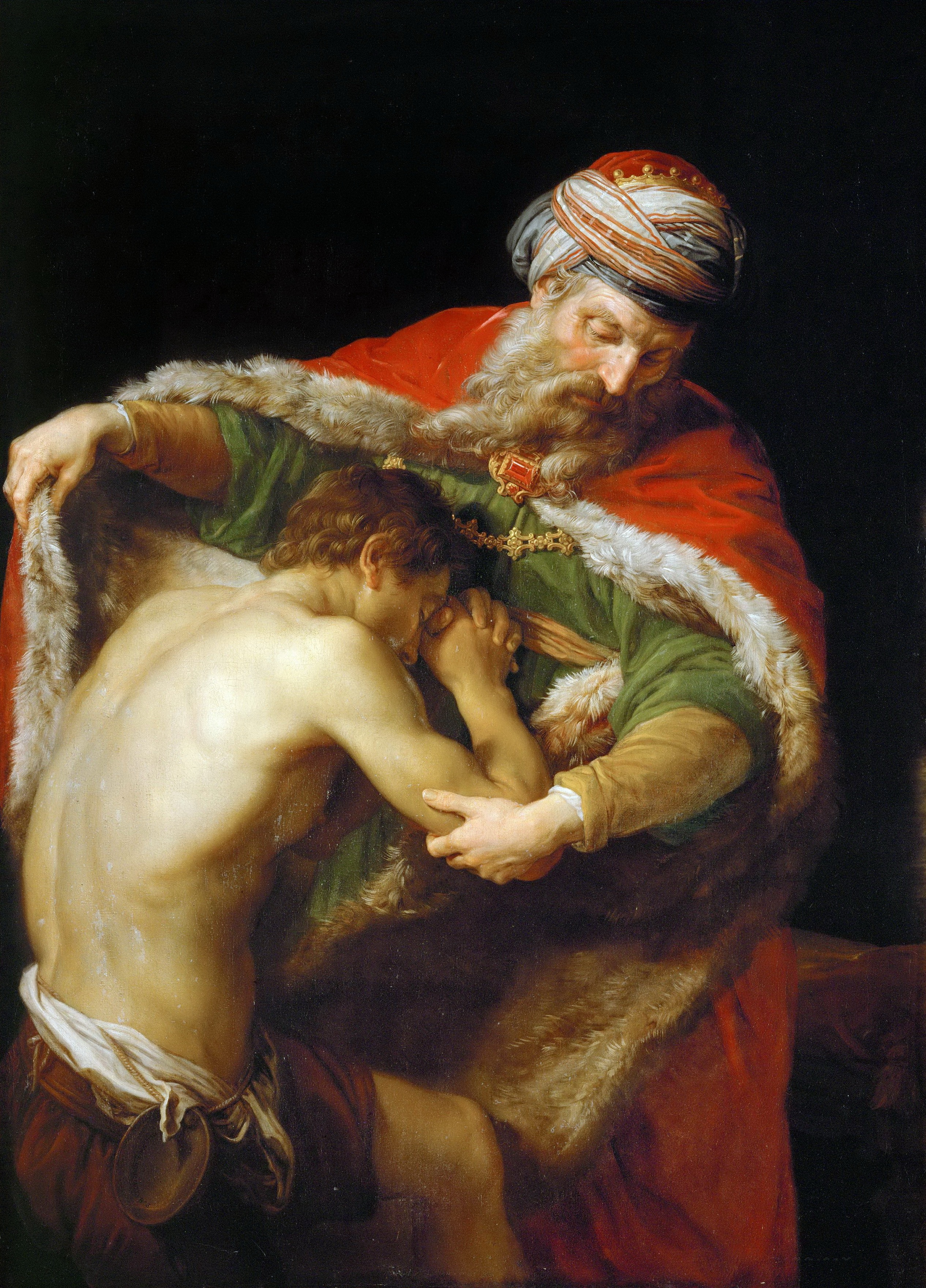
First off, pointing out the fact that the tension between Orlando and Oliver has ties to the parable of the prodigal son does not require much reading between the lines. Orlando speaks out against the pathetic conditions to which Oliver subjects him:
Shall I keep your hogs and eat husks with them? What prodigal portion have I spent that I should come to such penury? (I.1, 35-7)It's the prodigal son with a twist: Oliver subjects Orlando to life like a peasant, depriving him of the education and fortune promised in his father's will. Orlando pleads that age has no effect on the fact that he is as much Sir Roland de Boys' son as Oliver is, and that he is entitled to an inheritance that would liberate him from the grip that Oliver holds. It's the kind of reasoning that allowed the prodigal son in the parable to go out on his own, and arguably the father had this mindset when he welcomed the son home after taking a walk on the wild side. If I had to sum that rationale it up in a few words, I suppose they would be unconditional entitlement.
Another interesting bit jumped out at me when Orlando was pitted against Charles in a wrestling match. Charles, the duke's wrestler, was described in class as a "badass" of sorts. Orlando went into it as an underdog. Does this remind you of something? Well, it should.
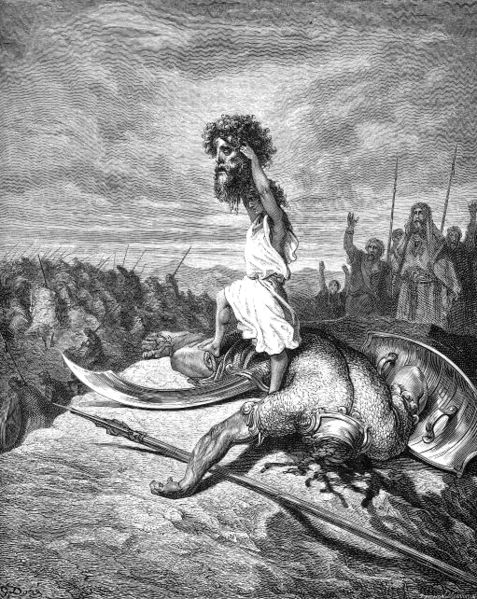
True, no beheading took place in this instance, but Orlando's defeat of Charles is unmistakably a David and Goliath story. Orlando accepts the challenge and overcomes insurmountable odds against him to overcome Charles, with enough energy to spare as he cockily declares "I am not yet well breathed" when the duke calls the match to stop. Granted, Orlando is banished for victory and not lauded like David was, but you get the idea.
I'm really impressed with the quality of blogging going on in the class. While mine is not quite as high-brow as others, hopefully it effectively conveys what I like about Shakespeare and about As You Like It. The Bible with a twist--and I assume it only gets better.
Subscribe to:
Posts (Atom)